Showing posts with label Innovation. Show all posts

Monday, November 1, 2010

Popping Bubbles

Bubble Wrap is a commonly used item found in almost every home. It is a great packaging tool for mailing items or for storing them. Because it is so flexible, it can be used for almost any item imaginable, from the very small to the very large, the very heavy to the precious and light. Bubble Wrap comes in different sizes and can be used and reused. It is also very commonly used as a pastime as both children and adults enjoy popping Bubble Wrap.


Although bubble wrap may seem fragile because it is made of thin layers of plastic and air, it is actually very strong and it can protect from impacts the most delicate objects like pocelane and glass. This type of packaging has revolutionized the way things are delivered and it is also a great stress reliever :D

Protect It, India

Eggs are recognized internationally as fragile and breakable. Playing off of the idea of eggs being fragile, these egg box from Max New York Life Insurance read, "Life is equally fragile. Protect it with life insurance."

http://inventorspot.com/articles/easter_egg_hunt_8_interesting_uses_eggs_advertising_11760

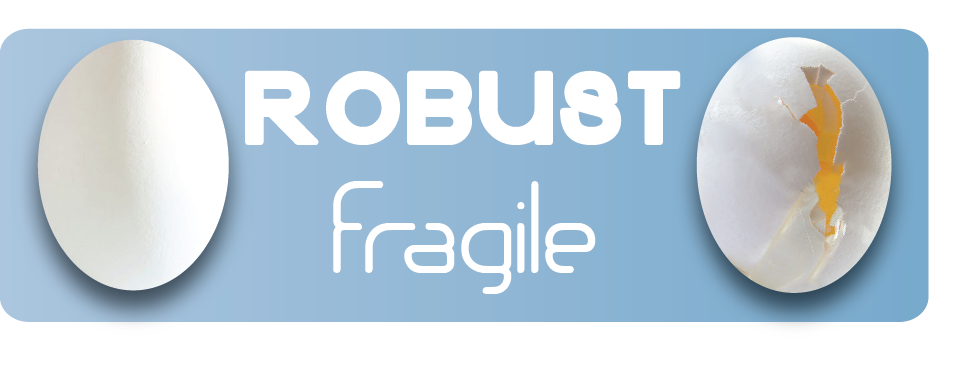
Here once againg  we see the egg appear one more time in our blog, but this time it is does not represent both our words. Although in this advertisment the egg is used to represent a fragile life, while the robust carboard box is used to represent protection.

Hard Banana


Robust case that ensures your banana survives your travels in perfect condition

http://www.toxel.com/inspiration/2009/04/04/20-unusual-and-creative-packaging-designs/


The skin of the bannana is very fragile and can be easily brusied. This package design was create to make the banana more robust so it can be protected during it's transportation. Yet another example of how a fragile thing can become robust with the right packaging. 

Automobile Museum by 3GATTI

Automobile museum in Nanjing.

It is difficult to identify one single and continuing exploratory theme in the work of Francesco Gatti. His aim is to experiment with heterogeneous solutions, each time meeting the challenge offered by his new creation’s specific conditions


From the ethereal virtual ceiling of the redevelopment project “In Factory” – his first Chinese work – to the curved forms of the Ze Bar, from the sculptural faceting of the Red Object to the spotted epidermis of his transgenic houses, the architect with Roman origins has never let himself be bound by a specific or recognisable aesthetic style.


 The same applies in the winning project for the new car museum at Nanchino where Gatti has envisaged an origami on urban scale.


http://milimet.net/2010/06/automobile-museum-by-3gatti-architecture-studio.html 

This project makes an abstraction of the orgami technique, the art of  folding paper into shapes representing objects, this technique use the fragility of the paper how it make a simple sheet turn in to a structure and then an object, it sitll look fragile not just because of the material is  also because of the hole meticulous process it has to go thru. 

The interesting thing about this project is how is built using  the stetic part of the origami technique and how it made look fragile this building even if has a completely  robust structure inside.


to buil a robust space  and make this building look still look even 
Tuesday, October 26, 2010

Charpy Impact Testing Machine

The Charpy impact test, also known as the Charpy v-notch test, is a standardized high strain-rate test which determines the amount of energy absorbed by a material during fracture. This absorbed energy is a measure of a given material's toughness and acts as a tool to study temperature-dependent brittle-ductile transition. It is widely applied in industry, since it is easy to prepare and conduct and results can be obtained quickly and cheaply. But a major disadvantage is that all results are only comparative.
The test was developed in 1905 by the French scientist Georges Charpy. It was pivotal in understanding the fracture problems of ships during the second World War. Today it is used in many industries for testing building and construction materials used in the construction of pressure vessels, bridges and to see how storms will affect materials used in building.

Quantitative Results: The quantitative result of the impact test—the energy needed to fracture a material—can be used to measure the toughness of the material and the yield strength. Also, the strain rate may be studied and analyzed for its effect on fracture.
The ductile-brittle transition temperature (DBTT) may be derived from the temperature where the energy needed to fracture the material drastically changes. However, in practice there is no sharp transition and so it is difficult to obtain a precise transition temperature. An exact DBTT may be empirically derived in many ways: a specific absorbed energy, change in aspect of fracture (such as 50% of the area is cleavage).

Qualitative Results: The qualitative results of the impact test can be used to determine the ductility of a material. If the material breaks on a flat plane, the fracture was brittle, and if the material breaks with jagged edges or shear lips, then the fracture was ductile. Usually a material does not break in just one way or the other, and thus comparing the jagged to flat surface areas of the fracture will give an estimate of the percentage of ductile and brittle fracture.

Kerbschlagbiegeversuch Maschine

The apparatus consists of a pendulum axe swinging at a notched sample of material. The energy transferred to the material can be inferred by comparing the difference in the height of the hammer before and after a big fracture. The notch in the sample affects the results of the impact test, hus it is necessary for the notch to be of a regular dimensions and geometry. The size of the sample can also affect results, since the dimensions determine whether or not the material is in plane strain. This difference can greatly affect conclusions made. he "Standard methods for Notched Bar Impact Testing of Metallic Materials" can be found in ASTM E23,  ISO 148-1,  or EN 10045-1, where all the aspects of the test and equipment used are described in detail.
Source: http://en.wikipedia.org/wiki/Charpy_impact_test 

Soft Statue

Jeff Koons (born January 21, 1955) is an American artist known for his reproductions of banal objects—such as balloon animals produced in stainless steel with mirror finish surfaces.
Koons' work has sold for substantial sums including at least one world record auction price for a work by a living artist. Critics are sharply divided in their views of Koons. Some view his work as pioneering and of major art-historical importance. Others dismiss his work as kitsch: crass and based on cynical self-merchandising. Koons has stated that there are no hidden meanings in his works. 

Balloon Dog (Magenta)


We have chosen this work of art  because although the sculpture is made out of steel  and it is 3 meters high, it represents a balloon animal which is actually very fragile and delicate.