Showing posts with label Literature. Show all posts

Thursday, November 11, 2010

J. Frazer, The Golden Bough

(Fragile, p.301a)
It would be idle, perhaps, to lay much weight on evidence drawn from the calendar of flowers, and in particular to press an argument so fragile as the bloom of the rose.

(Robust, p.499a)
These leaves were then distributed to everybody, old and young. When all was ready, a band of robust men, attended by a guard of exorcists, carried one of the cars down to the sea on the right side of the village graveyard, and set it floating in the water.

The Back Swan: on Robustness and Fragility

Nassim Nicholas Taleb is a Lebanese philosophical essayist, scholar and practitioner of mathematical financial economics. He is best known as the author of the 2007 book (completed 2010) The Black Swan. Taleb has been critical of the finance industry and has been credited with making warnings regarding financial crises and making a fortune out of the 2008 crisis. Taleb is an activist and a promoter of what he calls a "Black Swan robust" society as well as aggressive "stochastic tinkering" as a means of scientific discovery.


Three years after the pubication of The Black Swan, Nassin Nicholas Taleb write the new book, where he studies the 2008 crisis, and about the economists should analize and take care of it, with annotations that have the taste of the irony and the skepticism.
Robustness and fragility summerize three years old life of a strong idea, that it’s able to change and modify our mental paradigms. From these meetings it was born "Robustness and Fragility", his new philosophical story where, furnishing us a topographical paper of the Estremistan, Taleb it teaches us whether to move us in a world dominated by the case and by the uncertainty.

Tuesday, November 2, 2010

Robust Bookcovers

When we looked for books involving the word ROBUST in it's title we came across a large collection of engineering, design and method books. Most of this books talk about theories that can be applied to the real world. 


Fragile Bookcovers

When we looked for books with a title that have the word FRAGILE in it we discovered that most of the books are Fiction Novels which tell fantasy stories.


FRAGILE BEAST - Tawni O'Dell

FRAGILE ETERNITY - Melissa Marr

FRAGILE THINGS - Neil Gaiman
Source: www.amazon.com 

Tuesday, October 26, 2010

David and Goliath

The Israelites are facing the Philistines in the Valley of Elah. The boy David is bringing food to his older brothers who are with King Saul. He hears the Philistine giant Goliath challenging the Israelites to send their own champion to decide the outcome in single combat. David tells Saul he is prepared to face Goliath and Saul allows him to make the attempt. He is victorious, striking Goliath in the forehead with a stone from his sling, and the Philistines flee in terror. Saul sends to know the name of the young champion, and David tells him that he is the son of Jesse.
Davide con la testa di Golia, Caravaggio 1610
The physical fragility is represented by David in comparison to the gigantic Goliath.   But eventhough he is smaller, he is actually the winner of this scene.
Among the two of them, David personifies in a more correct maner the concept of a robust hero because he is strong of spirit and inteligent. Mean while Goliath belives to be superior than his adversary and he makes this judgement based only on his physical capacity. 

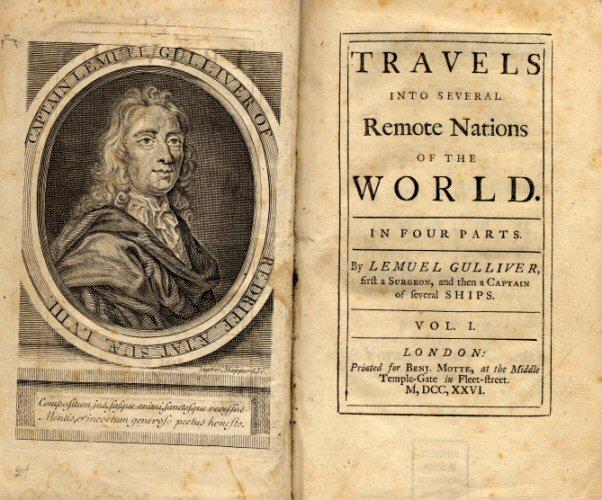
Gulliver's Travels


Gulliver's Travels (1726, amended 1735), officially Travels into Several Remote Nations of the World, in Four Parts. By Lemuel Gulliver, First a Surgeon, and then a Captain of several Ships, is a novel by Irish writer and clergyman Jonathan Swift that is both a satire on human nature and a parody of the "travellers' tales" literary sub-genre.

Part I: A voyage to Lilliput (4 May 1699 – 13 April 1702)
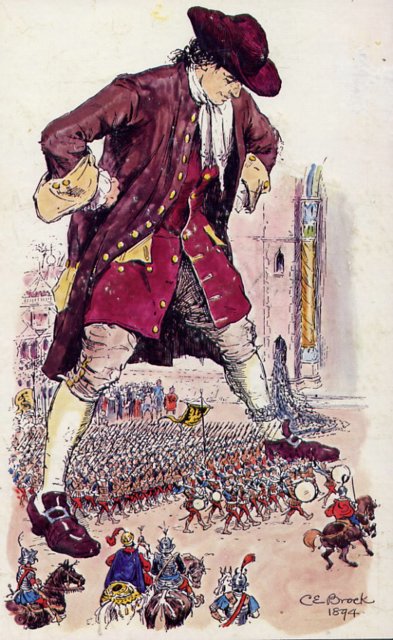
Gulliver’s adventure in Lilliput begins when he wakes after his shipwreck to find himself bound by innumerable tiny threads and addressed by tiny captors who are in awe of him but fiercely protective of their kingdom. They are not afraid to use violence against Gulliver, though their arrows are little more than pinpricks. But overall, they are hospitable, risking famine in their land by feeding Gulliver, who consumes more food than a thousand Lilliputians combined could. Gulliver is taken into the capital city by a vast wagon the Lilliputians have specially built. He is presented to the emperor, who is entertained by Gulliver, just as Gulliver is flattered by the attention of royalty. Eventually Gulliver becomes a national resource, used by the army in its war against the people of Blefuscu, whom the Lilliputians hate for doctrinal differences concerning the proper way to crack eggs. But things change when Gulliver is convicted of treason for putting out a fire in the royal palace with his urine and is condemned to be shot in the eyes and starved to death. Gulliver escapes to Blefuscu, where he is able to repair a boat he finds and set sail for England.
Source: http://en.wikipedia.org/wiki/Gulliver%27s_Travels


We have chosen this character because in two of his travels he represents both aspects of our words.  In one of his trips Gulliver is the fragile man that later becomes a robust gigant but because he is fragile of character he abuses of his power.
The character of Gulliver is a metaphor of those that make part of the occidental penal system, in particular the British system. 


Achille: Robust soldier, fragile man

In Greek mythologyAchilles (Ancient GreekἈχιλλεύςAchilleus) was a Greek hero of theTrojan War, the central character and the greatest warrior of Homer's Iliad.
Achilles also has the attributes of being the most handsome of the heroes assembled againstTroy.
Later legends (beginning with a poem by Statius in the first century AD) state that Achilles was invulnerable in all of his body except for his heel
According to the Achilleid, written by Statius in the first century AD, and to no surviving previous sources, when Achilles was born Thetis (his mother) tried to make him immortal by dipping him in the river Styx and making him invulnerable. However, he was left vulnerable at the part of the body by which she held him, his heel. 

Since he died due to a poisonous arrow shot into his heel, the term "Achilles' heel" has come to mean a person's principal weakness
Villa Reale, Milano

We have chosen the character Achilles to represent our pair of antonyms because we think that he represents both of them very well. With his muscular body and strength he represents ROBUST, but his heel shows his real weakness and how FRAGILE  he really is. 


Tuesday, October 19, 2010

A Robustious Periwig-pated Fellow

-Act III, scene 2-

Scene: A hall in the castle.
            Hamlet and the Player

Hamlet:
Speak the speech, I pray you, as I pronounced it to 
you, trippingly on the tongue: but if you mouth it,
as many of your players do, I had as lief the
town-crier spoke my lines. Nor do not saw the air
too much with your hand, thus, but use all gently;
for in the very torrent, tempest, and, as I may say,
the whirlwind of passion, you must acquire and beget
a temperance that may give it smoothness. O, it
offends me to the soul to hear a robustious
periwig-pated fellow tear a passion to tatters, to 
very rags, to split the ears of the groundlings, who
for the most part are capable of nothing but
inexplicable dumbshows and noise: I would have such
a fellow whipped for o'erdoing Termagant; it
out-herods Herod: pray you, avoid it.


First Player:
I warrant your honour. 


"Speak the speech" is a famous speech from Shakespeare's Hamlet (1601). In it, Hamlet offers directions and advice to a group of actors whom he has enlisted to play for the court of Denmark. We found very interesting the way the author uses this word in this speech and since Hamlet is one of the greatest works ever written by Shakespeare we wanted to share.