Tuesday, October 26, 2010

Popeye & Olivia: opposites attract

Popeye the Sailor is a fictional hero notable for appearing in comic strips and animated films as well as numerous television shows. He was created by Elzie Crisler Segar, and first appeared in the daily King Features comic strip Thimble Theatre on January 17, 1929. Olive Oyl is actually older than Popeye, she appeared in the comic strip Thimble Theatre since  1919. The strip was later renamed Popeye after the sailor character that became the most popular member of the cast; however Olive Oyl was a main character for 10 years before Popeye's 1929 appearance.

In the films and later television cartoons, Olive Oyl is Popeye's girlfriend, although she could be extremely fickle, depending on who could woo her the best or had the flashier possessions, and was prone to get angry over the tiniest things. She constantly gets kidnapped by Bluto(aka Brutus), who is Popeye's archrival for her affections, but Popeye always rescues her, winning her affection in the end.


This particular couple exceptionally represents the fragility and the robustness, he is strong and brave and she is weak and always in distress. Physically they are also very different, he it short but muscular and she it tall and boney, but it their love for each other that keep this awkward couple together. 

Soft Statue

Jeff Koons (born January 21, 1955) is an American artist known for his reproductions of banal objects—such as balloon animals produced in stainless steel with mirror finish surfaces.
Koons' work has sold for substantial sums including at least one world record auction price for a work by a living artist. Critics are sharply divided in their views of Koons. Some view his work as pioneering and of major art-historical importance. Others dismiss his work as kitsch: crass and based on cynical self-merchandising. Koons has stated that there are no hidden meanings in his works. 

Balloon Dog (Magenta)


We have chosen this work of art  because although the sculpture is made out of steel  and it is 3 meters high, it represents a balloon animal which is actually very fragile and delicate. 

Proverbs

More ROBUST than the nose of a lion. (Arabic proverb)


Man is harder than iron, stronger than stone, and more FRAGILE than a rose. (Turkish Proverb)

Wednesday, October 20, 2010

The Titans

In Greek mythology, the Titans (Ancient Greek: Τιτάν - Ti-tan; plural: Τιτᾶνες - Ti-tânes) were a race of powerful deities, descendants of Gaia and Uranus, that ruled during the legendary Golden Age. The role of the Titans as Elder Gods was overthrown by a race of younger gods, the Olympians, in the Titanomachy ("Battle with the Titans") which effected a mythological paradigm shift that the Greeks may have borrowed from the Ancient Near East.
In the first generation of twelve Titans, they are:
    * Coeus - The titan of wisdom.
    * Crius - The titan of strength and power.
    * Cronus - The king of the Titans.
    * Iapetus - The titan of mortality.
    * Oceanus - The titan of the rivers.
    * Hyperion - The titan of supervision and compliance.
    * Mnemosyne – The titanessa of memories
    * Phoebe – The titanessa of darkness .
    * Rhea – The queen of Titans.
    * Tethys - The titanessa of the rivers.
    * Theia - The titanessa of sight and light.
    * Themis - The titanessa of justice.
The second generation of Titans consisted of Hyperion's children Eos, Helios, and Selene; Coeus's daughters Leto and Asteria; Iapetus's sons Atlas, Prometheus, Epimetheus, and Menoetius; and Crius's sons Astraeus, Pallas, and Perses.
In particular in Greek mythology, Crius, Kreios or Krios (Ancient Greek: Κρεῖος, Κριός) was one of the Titans in the list given in Hesiod's Theogony, a son of Uranus and Gaia. The least individualized among them, he was overthrown in the Titanomachy. M.L. West has suggested how Hesiod filled out the complement of Titans from the core group— adding three figures from the archaic tradition of Delphi, Koios, Phoibe, whose name Apollo assumed with the oracle, and Themis. Among possible further interpolations among the Titans was Kreios, whose interest for Hesiod was as the father of Perses and grandfather of Hekate, for whom Hesiod was, according to West, an "enthusiastic evangelist".
Joined to fill out lists of Titans to form a total that made a match with the Twelve Olympians, Crius/Kreios was inexorably involved in the eleven-year-long war between the Olympian gods and Titans, the Titanomachy, however without any specific part to play. When the war was lost, Crius/Kreios was banished along with the others to the lower level of Hades called Tartarus. From his chthonic position in the Underworld, no classical association with Aries, the "Ram" of the zodiac, is ordinarily made.


Tuesday, October 19, 2010

House of Cards

In this image the "robustness" is portrayed by a house of cards, which is made of fragile pieces of paper (cards). The cartoon shows how together they can create a strong solid stucture, but that the same one can be easily destroyed due to it's weak fundations.

Despicable Me


This trailer shows how a plastic balloon, which is a fairly fragile object, can be robust at the same time when inflated with air. When the little boy hugs the balloon animal this one remains intact, but when the man touches it with a needle, this one pops.

Freezing Objects

Be believe that ice objects represent very well our two opposite concepts because although the ice can be very strong and resistant to be carved into objects such as this violin, an ice sculpture or even make a shelter, at the same time it may also be easily  shattered into many pieces or it can melt with the rise of temperature, which makes it very fragile.


A Robustious Periwig-pated Fellow

-Act III, scene 2-

Scene: A hall in the castle.
            Hamlet and the Player

Hamlet:
Speak the speech, I pray you, as I pronounced it to 
you, trippingly on the tongue: but if you mouth it,
as many of your players do, I had as lief the
town-crier spoke my lines. Nor do not saw the air
too much with your hand, thus, but use all gently;
for in the very torrent, tempest, and, as I may say,
the whirlwind of passion, you must acquire and beget
a temperance that may give it smoothness. O, it
offends me to the soul to hear a robustious
periwig-pated fellow tear a passion to tatters, to 
very rags, to split the ears of the groundlings, who
for the most part are capable of nothing but
inexplicable dumbshows and noise: I would have such
a fellow whipped for o'erdoing Termagant; it
out-herods Herod: pray you, avoid it.


First Player:
I warrant your honour. 


"Speak the speech" is a famous speech from Shakespeare's Hamlet (1601). In it, Hamlet offers directions and advice to a group of actors whom he has enlisted to play for the court of Denmark. We found very interesting the way the author uses this word in this speech and since Hamlet is one of the greatest works ever written by Shakespeare we wanted to share.


Monday, October 18, 2010

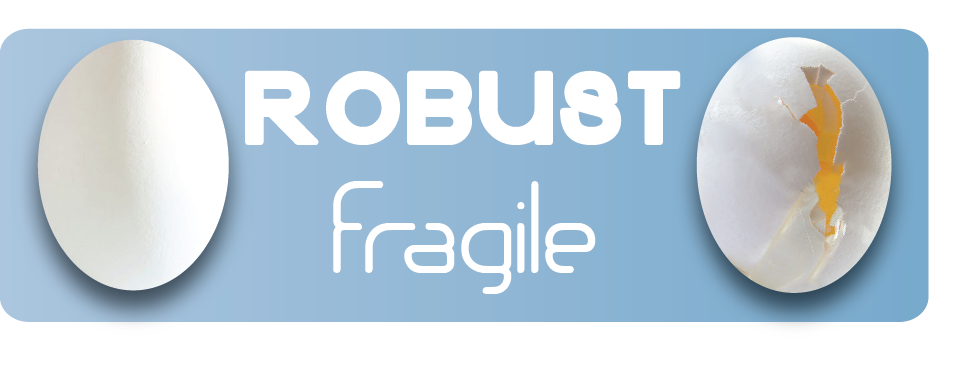
The egg: robust or fragile?


We have chosen the egg as the object to represent both Fragile and Robust because due to its physical proprerties it can be both. In nature the egg has to be robust enough to protect the baby chick from it suroundings, and the mother has to be able to sit on top of it and warm it without this one breaking. Meanwhile it also has to be fragile enough so that the baby chick with almost no strength can break through it with it weak beak. 
If you analyze the antomy of an egg you will discover that it sides are very weak and can be easily broken (thats why we crack the sides of an egg and not its top) while the top and the bottom are the stongest parts of the shell that can resist enormous amounts of weight and pressure. 

what is fragile?

Etymology: It comes from a Latin word "fragilis-e", it appears for the first time in 1510s as liable to sin, then in XV century as liable to break.
It's define as:
  • easily broken or destroyed "a fragile vase" 
  • constitutionally delicate : lacking in vigor "a fragile child"